

UCAT Access Arrangements
Five versions of the UCAT exist: one standard time, and then several versions that incorporate various access arrangements, consisting of additional time, pause-the-clock rest breaks and longer instruction sections. The exam content is exactly the same, but the timings are different in each case. These versions of the exam exist to ensure a fair exam across all student needs. For those with conditions such as dyslexia or dyscalculia, extra time will help even the playing field.
The various access permutations available are as follows:
UCAT Exam Title | Description |
UCAT | 117 minutes 30 seconds. Standard test with no additional time. |
UCATSA | 117 minutes 30 seconds, plus up to 20 minutes pause-the-clock rest breaks. |
OnVUE UCAT SA | 137 minutes 30 seconds, including fixed 5-minute instruction sections before each subset of questions. |
UCATSEN / OnVUE UCATSEN | 145 minutes 15 seconds, for candidates eligible for 25% additional time. |
UCATSENSA | 145 minutes 15 seconds, including 25% additional time, plus up to 25 minutes pause-the-clock rest breaks. |
OnVUE UCATSENSA | 170 minutes 15 seconds, including 25% additional time and fixed 6 minute 15 second instruction sections before each subset of questions. |
UCATSEN50 / OnVUE UCATSEN50 | 173 minutes, for candidates eligible for 50% additional time. |
UCATSENSA50 | 173 minutes, including 50% additional time, plus up to 30 minutes pause-the-clock rest breaks. |
It is important that those sitting the UCAT with rests breaks and/or additional time know that this will not disadvantage them in any way when applying to university. Medical/Dentistry schools won't even know that you sat a different form of the UCAT! As a result of this, if you are eligible for extra time and/or rest breaks, we strongly advise you to request access arrangements when booking your test in order to give yourself the best chance of success.
How to apply for access arrangements
You must apply for your access arrangements before booking your UCAT test. In order to ensure that your access arrangements are granted in good time, we advise you to apply at least two weeks before you intend to make your booking.
Here is a stepwise list to help you apply for access arrangements:
- First, you need to register for your UCAT account.
- An access arrangements application form can be found on the UCAT website. As well as completing this form, you will need to upload evidence (see below) that supports your claim.
- Within a week you should hear back via email regarding your access arrangements, and you will be informed whether they have been accepted or not.
- If they are accepted, you will be emailed instructions regarding how to book your test with your appropriate access arrangements. If they are not accepted, you will need to book a normal-time test.
What counts as evidence?
The easiest evidence to provide will often be a signed letter on headed paper from your current/most recent (within the last 2 years) school, sixth form, or other educational institution. This letter should state the access arrangements you currently have in place, and the basis on which these arrangements were agreed: e.g. whether a diagnosis was made by a medical professional or an educational psychologist, etc.
Another option is to provide a document called the ‘JCQ Form 8/9 Application for Access Arrangements’. Those having existing arrangements with particular exam boards may have completed this form, and, if this is the case, you can ask your educational institution for a copy of the form as evidence for UCAT access arrangements. You may have completed this form if you have any of the following additional arrangements:
- 25% or more additional time
- Scribe
- Word processor use (with or without grammar/spell check enabled)
- Speech recognition technology
- Language modifier
If it is more than two years since you left school or college, you can instead provide a recent letter from a GP or specialist, or a full diagnostic assessment report, stating the recommended extra time or other accommodations. Bear in mind, however, that if you do not already have such a letter or assessment, they can take some time to organise, especially in the case of NHS clinics, so you will need to start the whole UCAT process even earlier. It is always possible to pay for private assessments, but the price can be high, so you should be prepared.
How rest breaks work
The UCATSA, UCATSENSA and UCATSENSA50 are tests that all include rest breaks: these are simply proportionate breaks where the timer stops and you can take a breather. They are referred to as ‘pause-the-clock’ rest breaks, meaning you can stop the timer at any point during the exam for the total amount of time (either 20, 25 or 30 minutes that you are given, depending on whether you receive access to UCATSA, UCATSENSA or UCATSENSA50, respectively. During this time, you are permitted to get up and leave the room if need be, or stay sat at your desk. You must be careful, however, not to over-run your rest break allocation, as the question timer will automatically restart and you will lose valuable time.
There are also the OnVUE UCATSA and OnVUE UCATSEN50 variations on the test that, in the place of pause-the-clock rest breaks, give you fixed 5-minute (in the case of OnVUE UCATSA) or 6 minute 15 second (in the case of OnVUE SENSA50) instructions before each of the four subsets of questions. The test itself, however, is not paused, and each subsequent section will begin as soon as the timed instruction period ends.
Other Access arrangements
Certain access arrangements do not need to be pre-approved before booking your test. Some of these are items that can be brought along on the day and inspected by the staff before entering the exam room, while others must be arranged with the exam centre at least five working days before the UCAT. Additionally, however, some requests require approval before booking your test.
UCAT provides an extensive list of items requiring no arrangements, designated as ‘comfort aids’:
- Medical items:
- Bandages, braces, casts, inhalers, eye patches, inhalers, and EpiPens
- Oxygen tanks
- Cough drops, eye drops
- Continuous glucose monitors, insulin pumps, TENS units
- Medication tablets (in the original packaging)
- Glucose tablets - unwrapped and not in a container - Medical aids
- Medical footstool (to support an injured leg or foot, no larger than 14x14x12cm)
- Hearing aids/cochlear implant - Pillow/Cushion
- Mobility devices
- Canes, crutches, motorised scooters/chairs, walkers, wheelchairs - Earplugs and noise-reducing headphones (provided by the test centre)
- Face mask and/or gloves
- Handheld non-electronic magnifying glass
- Tissues (provided by the test centre)
Items requiring pre-approval at least five working days before your test:
- Wheelchair access or adjustable height desk
- ZoomText
- Coloured overlay
Items requiring approval before booking your test:
- A separate room
- This room is a quieter, less busy testing environment
- Note that not all test centres are able to offer separate rooms - The use of medicines or medical devices during the test, as well as the consumption of particular forms of food and drink
- This will require a separate room
- Certain rules apply for food/drink even if pre-approved eg. drinks need to be in a clear bottle and food in a small see-through bag
The Timings
The following tables lay out the different timings for each section of the UCAT, according to the type of access arrangement granted.
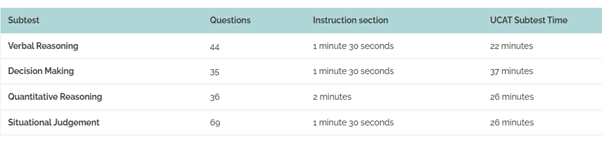
1. UCAT (117 minutes 30 seconds)
This is the standard test, consisting of five sections, of which each section is preceded by a one-two minute instruction section. The examination runs continuously. The timings and number of questions in each respective section is as follows:
2. UCATSA (up to 137 minutes 30 seconds)
This is exactly the same exam as the standard UCAT, but is for candidates who are eligible for rest breaks. It includes an additional 20 minutes for pause-the-clock breaks, making a maximum exam time of 137 minutes 30 seconds. Pauses can be taken at any point during the exam, up to a maximum of 20 minutes, using the built in pause facility.
3. OnVUE UCATSA (137 minutes 30 seconds)
The same exam as the standard UCAT, but in this version, there are fixed five-minute instruction sections before each subset, rather than just 1min30 / 2mins. There are no pause-the-clock breaks.
4. UCATSEN / OnVUE UCATSEN (145 minutes 15 seconds)
This is the same exam as the standard UCAT, but is for candidates who are eligible for 25% extra time. Timings of each section are as follows:

5. UCATSENSA (up to 170 minutes 15 seconds)
For candidates eligible for 25% extra time and rest breaks. Consists of the same timings as the UCATSEN with the addition of 25 minutes of on-demand pause-the-clock breaks.
6. OnVUE UCATSENSA (170 minutes 15 seconds)
25% extra time plus fixed 6 minute 15 second instruction sections before each subset, rather than just 1min30 / 2mins. There are no pause-the-clock breaks.
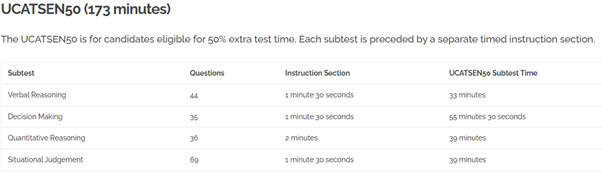
7. UCATSEN50 / OnVUE UCATSEN50 (173 minutes)
For candidates eligible for 50% extra time in each subset of questions. Timings of each section are as follows:
8. UCATSEN50SA (up to 203 minutes)
For candidates eligible for 50% extra time and rest breaks. Consists of the same timings as the UCATSEN with the addition of 30 minutes of on-demand pause-the-clock breaks.
Diabetics
UCAT provides specific advice for those who have diabetes. This information is summarised below:
Regarding your diabetes and its management on the day, you are allowed to take into the exam glucose tables and a continuous glucose monitor/insulin pump. These items do not need to be pre-approved; you simply arrive on the day and the items will be checked by the invigilators. Note, however, that glucose tablets should be unwrapped and loose in a clear bag. Thankfully, UCAT makes this experience fairly easy, however, the one exception is if you need to use an insulin pump that makes any noise. If this is the case for you, then you must apply in advance for a separate room. Note, also, that if your pump requires any form of external remote control, this needs to be pre-approved otherwise it will not be allowed in the exam room.
Some further pre-approved items for diabetics can be brought into the exam room, but certain rules apply:
- If you have written medical confirmation that you require any of the following items, you can apply for permission to have them in the exam room at your workstation. To support these requests, however, you are required to sit your test in a separate room, so you must apply to a test centre that can support this. The following items can be accommodated:
- Diabetic testing equipment
- Food/drink, subject to the following rules:
-- Food and drink must be in transparent containers.
-- Hard candy must be unwrapped.
-- Any consumables must be kept away from the workstation while engaging in the test and not consumed over or near the workstation.
- Mobile phones which monitor glucose.
-- If there is no SIM card, a phone can be used as a diabetes-monitoring device. - Finally, it should be noted that if you are a diabetic and you become ill during your test, you must notify the invigilator, so that your illness can be recorded. If you cannot continue and need to leave before completing the test, you can contact the UCAT team (ucat@nottingham.ac.uk) to re-organise your test. This must be done to within one working day of the abandoned test.